
A Conversation with Diane Gromala
Original Appears in LFA Emigre #31, 1994
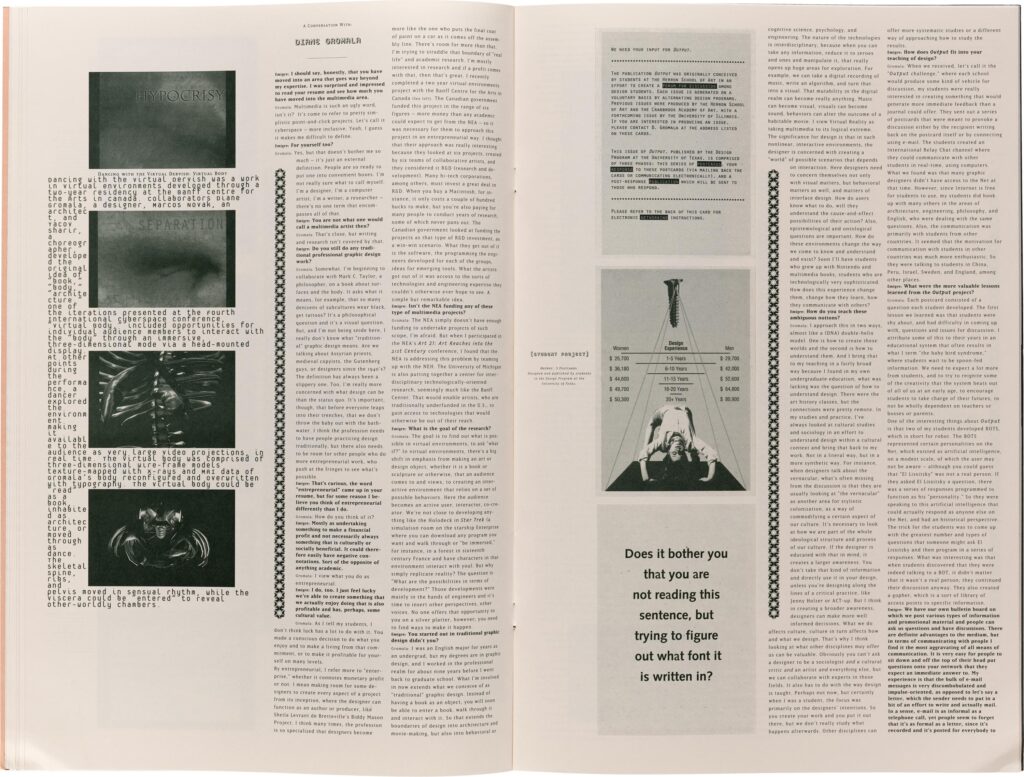
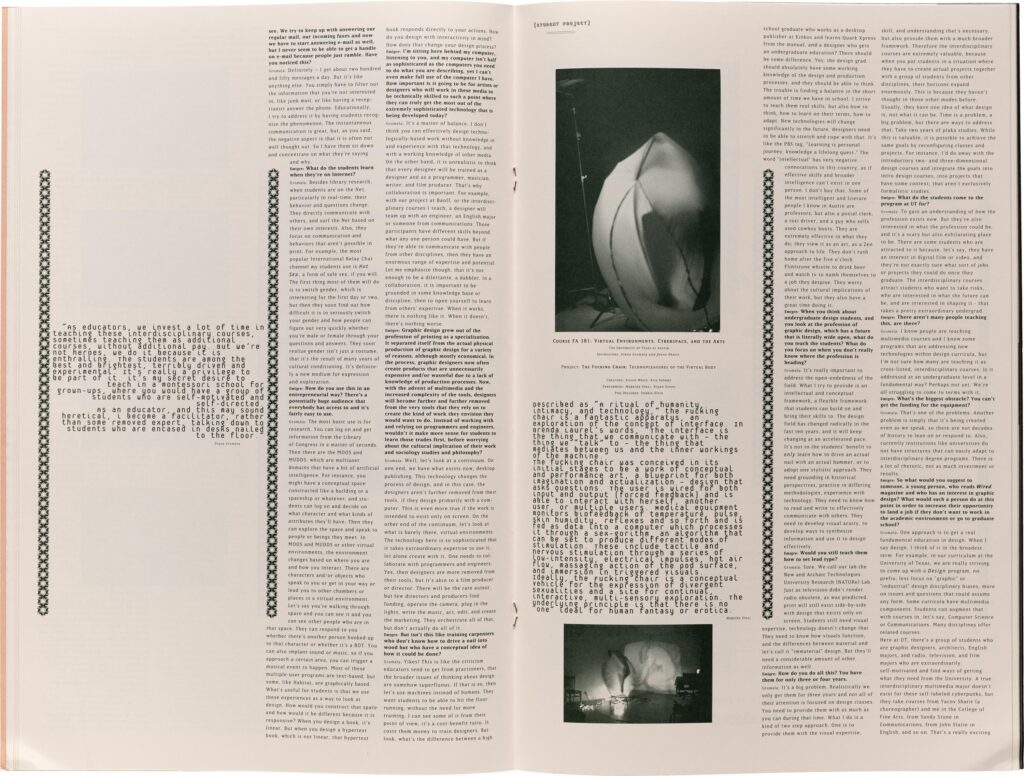
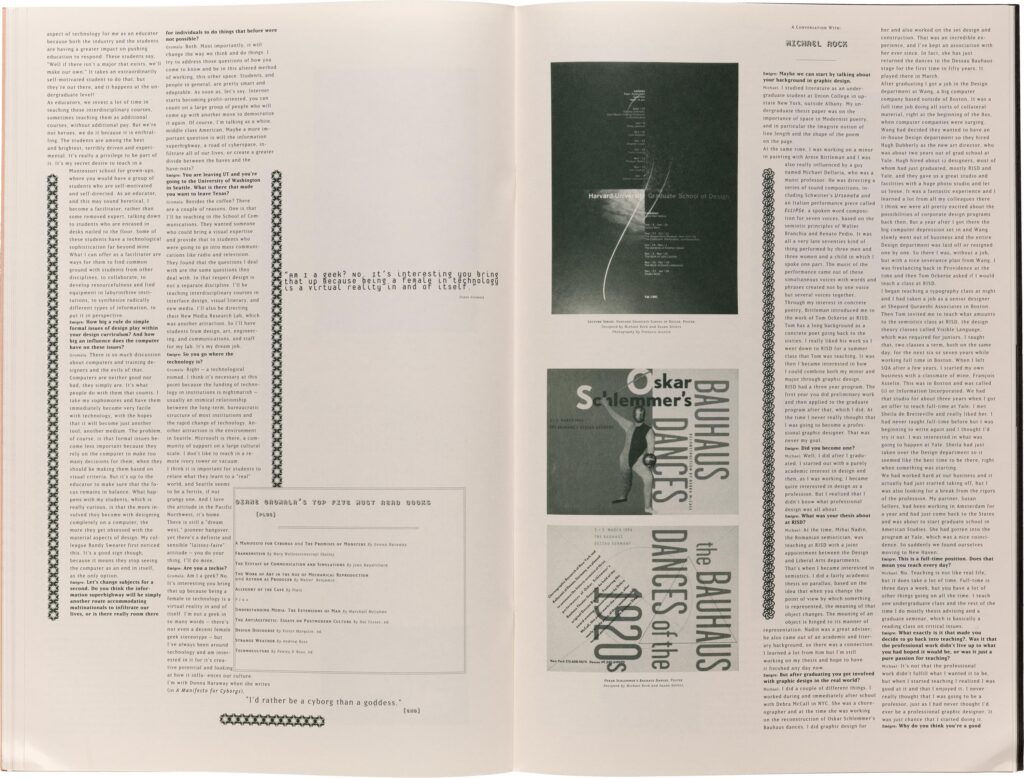
Emigre: I should say, honestly, that you have moved into an area that goes way beyond my expertise. I was surprised and impressed to read your resume and see how much you have moved into the multimedia area.
Gromala: Multimedia is such an ugly word, isn’t it? It’s come to refer to pretty simplistic point-and-click projects. Let’s call it cyberspace—more inclusive. Yeah, I guess it makes me difficult to define.
Emigre: For yourself too?
Gromala: Yes, but that doesn’t bother me so much—it’s just an external definition. People are so ready to put one into convenient boxes. I’m not really sure what to call myself. I’m a designer, I’m a computer artist, I’m a writer, a researcher—there’s no one term that encompasses all of that.
Emigre: You are not what one would call a multimedia artist then?
Gromala: That’s close, but writing and research isn’t covered by that.
Emigre: Do you still do any traditional professional graphic design work?
Gromala: Somewhat. I’m beginning to collaborate with Mark C. Taylor, a philosopher, on a book about surfaces and the body. It asks what it means, for example, that so many denizens of subcultures wear black, get tattoos? It’s a philosophical question and it’s a visual question. But, and I’m not being snide here, I really don’t know what “traditional” graphic design means. Are we talking about Assyrian priests, medieval copyists, the Gutenberg guys, or designers since the 1940’s? The definition has always been a slippery one. Too, I’m really more concerned with what design can be than the status quo. It’s important, though, that before everyone leaps into their trenches, that we don’t throw the baby out with the bathwater. I think the profession needs to have people practicing design traditionally, but there also needs to be room for other people who do more entrepreneurial work, who push at the fringes to see what’s possible.
Emigre: That’s curious, the word “entrepreneurial” came up in your resume, but for some reason I believe you think of entrepreneurial differently than I do.
Gromala: How do you think of it?
Emigre: Mostly as undertaking something to make a financial profit and not necessarily always something that is culturally or socially beneficial. It could therefore easily have negative connotations. Sort of the opposite of anything academic.
Gromala: I view what you do as entrepreneurial.
Emigre: I do, too. I just feel lucky we’re able to create something that we actually enjoy doing that is also profitable and has, perhaps, some cultural value.
Gromala: As I tell my students, I don’t think luck has a lot to do with it. You made a conscious decision to do what you enjoy and to make a living from that commitment, or to make it profitable for yourself on many levels.
By entrepreneurial, I refer more to “enterprise,” whether it connotes monetary profit or not. I mean making room for some designers to create every aspect of a project from its inception, where the designer can function as an author or producer, like Sheila Levrant de Bretteville’s Biddy Mason Project. I think many times, the profession is so specialized that designers become more like the one who puts the final coat of paint on a car as it comes off the assembly line. There’s room for more than that. I’m trying to straddle that boundary of “real life” and academic research. I’m mostly interested in research and if a profit comes with that, then that’s great. I recently completed a two year virtual environments project with the Banff Centre for the Arts in Canada (See left). The Canadian government funded this project in the range of six figures—more money than any academic could expect to get from the NEA—so it was necessary for them to approach this project in an entrepreneurial way. I thought that their approach was really interesting because they looked at six projects, created by six teams of collaborative artists, and they considered it R&D (research and development). Many hi-tech corporations, among others, must invest a great deal in R&D. When you buy a Macintosh, for instance, it only costs a couple of hundred bucks to make, but you’re also paying for many people to conduct years of research, some of which never pans out. The Canadian government looked at funding the projects as that type of R&D investment, as a win-win scenario. What they get out of it is the software, the programming the engineers developed for each of the groups, ideas for emerging tools. What the artists got out of it was access to the sorts of technologies and engineering expertise they couldn’t otherwise ever hope to see. A simple but remarkable idea.
Emigre: Isn’t the NEA funding any of these type of multimedia projects?
Gromala: The NEA simply doesn’t have enough funding to undertake projects of such scope, I’m afraid. But when I participated in the NEA’s Art 21: Art Reaches into the 21st Century conference, I found that the NEA is addressing this problem by teaming up with the NEH. The University of Michigan is putting together a center for interdisciplinary technologically-oriented research, seemingly much like the Banff Center. That would enable artists, who are traditionally underfunded in the U.S., to gain access to technologies that would otherwise be out of their reach.
Emigre: What is the goal of the research?
Gromala: The goal is to find out what is possible in virtual environments, to ask “what if?” In virtual environments, there’s a big shift in emphasis from making an art or design object, whether it is a book or sculpture or otherwise, that an audience comes to and views, to creating an interactive environment that relies on a set of possible behaviors. Here the audience becomes an active user, interactor, co-creator. We’re not close to developing anything like the Holodeck in Star Trek (a simulation room on the starship Enterprise where you can download any program you want and walk through or “be immersed,” for instance, in a forest in sixteenth century France and have characters in that environment interact with you). But why not replicate reality? The question is—
Emigre: You started out in traditional graphic design didn’t you?
Gromala: I was an English major for years as an undergrad, but my degrees are in graphic design, and I worked in the professional realm for about nine years before I went back to graduate school. What I’m involved in now extends what we conceive of as “traditional” graphic design. Instead of having a book as an object, you will soon be able to enter a book, walk through it and interact with it. So that extends the boundaries of design into architecture and movie-making, but also into behavioral or cognitive science, psychology, and engineering. The nature of the technologies is interdisciplinary, because when you can take any information, reduce it to zeroes and ones and manipulate it, that really opens up huge areas for exploration. For example, we can take a digital recording of music, write an algorithm, and turn that into a visual. That mutability in the digital realm can become really anything. Music can become visual, visuals can become sound, behaviors can alter the outcome of a habitable movie. I view Virtual Reality as taking multimedia to its logical extreme. The significance for design is that in such nonlinear, interactive environments, the designer is concerned with creating a “world” of possible scenarios that depends upon user interaction. Here designers need to concern themselves not only with visual matters, but behavioral issues as well, and matters of interface design. How do users know what to do, will they understand the cause-and-effect possibilities of their action? Also, epistemological and ontological questions are important. How do these environments change the way we come to know and understand and exist? Soon I’ll have students who grew up with Nintendo and multimedia books, students who are technologically very sophisticated. How does this experience change them, change how they learn, how they communicate with others?
Emigre: How do you teach these ambiguous notions?
Gromala: I approach this in two ways, almost like a (DNA) double-helix model. One is how to create these worlds and the second is how to understand them. And I bring that to my teaching in a fairly broad way because I found in my own undergraduate education, what was lacking was the question of how to understand design. There were the art history classes, but the connections were pretty remote. In my studies and practice, I’ve always looked at cultural studies and sociology in an effort to understand design within a cultural context and bring that back to my work. Not in a literal way, but in a more synthetic way. For instance, when designers talk about the vernacular, what’s often missing from the discussion is that they are usually looking at “the vernacular” as another area for stylistic colonization, as a way of commodifying a certain aspect of our culture. It’s necessary to look at how we are part of the whole ideological structure and process of our culture. If the designer is educated with that in mind, it creates a larger awareness. You don’t take that kind of information and directly use it in your design, unless you’re designing along the lines of a critical practice, like Jenny Holzer or ACT-up. But I think in creating a broader awareness, designers can make more well informed decisions. What we do affects culture, culture in turn affects how and what we design. That’s why I think looking at what other disciplines may offer us can be valuable. Obviously you can’t ask a designer to be a sociologist and a cultural critic and an artist and everything else, but we can collaborate with experts in those fields. It also has to do with the way design is taught. Perhaps not now, but certainly when I was a student, the focus was primarily on the designer’s intentions. So you create your work and you put it out there, but we don’t really study what happens afterwards. Other disciplines can offer more systematic studies or a different way of approaching how to study the results.
Emigre: How does Output fit into your teaching of design?
Gromala: When we received, let’s call it the “Output challenge,” where each school would produce some kind of vehicle for discussion, my students were really interested in creating something that would generate more immediate feedback than a journal could offer. They sent out a series of postcards that were meant to provoke a discussion either by the recipient writing back on the postcard itself or by connecting using e-mail. The students created an International Relay Chat channel where they could communicate with other students in real-time, using computers. What we found was that many graphic designers didn’t have access to the Net at that time. However, since Internet is free for students to use, my students did hook up with many others in the areas of architecture, engineering, philosophy, and English, who were dealing with the same questions. Also, the communication was primarily with students from other countries. It seemed that the motivation for communication with students in other countries was much more enthusiastic. So they were talking to students in China, Peru, Israel, Sweden, and England, among other places.
Emigre: What were the more valuable lessons learned from the Output project?
Gromala: Each postcard consisted of a question each student developed. The first lesson we learned was that students were shy about, and had difficulty in coming up with, questions and issues for discussion. I attribute some of this to their years in an educational system that often results in what I term “the baby bird syndrome.” That is, students get the spoon-fed information. We need to expect a lot more from students, and to try to reignite some of the creativity that the system beats out of all of us at an early age, to encourage students to take charge of their futures, to not be wholly dependent on teachers or bosses or parents.
One of the interesting things about Output is that two of my students developed BOTS, which is short for robot. The BOTS represented certain personalities on the Net, which existed as artificial intelligence, on a modest scale, of which the user may not be aware—although you could guess that “El Lissitzky” was not a real person. If they asked El Lissitzky a question, there was a series of responses programmed to function as his “personality.” So they were speaking to this artificial intelligence that could actually respond as anyone else on the Net, and had an historical perspective. The trick for the students was to come up with the greatest number and types of questions that someone might ask El Lissitzky and then program in a series of responses. What was interesting was that when students discovered they were indeed talking to a BOT, it didn’t matter to them. They continued their discussion anyway. They also created a gopher, which is a sort of library of access points to specific information.
Emigre: We have our own bulletin board on which we post various types of information and promotional material and people can ask us questions and have discussions. There are definite advantages to the medium, but in terms of communicating with people I find it the most aggravating of all means of communication. It is very easy for people to sit down and off the top of their head put questions onto your network that they expect an immediate answer to. My experience is that the bulk of e-mail messages is very discombobulated and impulse-oriented, as opposed to let’s say a letter, which the sender needs to put in a bit of an effort to write and actually mail. In a sense, e-mail is as informal as a telephone call, yet people seem to forget that it’s as formal as a letter, since it’s recorded and it’s posted for everybody to Emigre: We try to keep up with answering our regular mail, our incoming faxes and now we have to start answering e-mail as well, but I never seem to be able to get a handle on e-mail because people just ramble. Have you noticed this?
Gromala: Definitely—I get about two hundred and fifty messages a day. But it’s like anything else. You simply have to filter out the information that you’re not interested in, like junk mail, or like having a receptionist answer the phone. Educationally, I try to address it by having students recognize the phenomenon. The instantaneous communication is great, but, as you said, the negative aspect is that it is often not well thought out. So I have them sit down and concentrate on what they’re saying and why.
Emigre: What do the students learn when they’re on Internet?
Gromala: Besides library research, when students are on the Net, their behavior and questions change. They directly communicate with others, and surf the Net based on their own interests. Also, they focus on communication and behaviors that aren’t possible in print. For example, the most popular International Relay Chat channel my students use is Hot Sex, a form of safe sex, if you will. The first thing most of them will do is to switch gender, which is interesting for the first day or two, but then they soon find out how difficult it is to seriously switch your gender and how people can figure out very quickly whether you’re male or female through your questions and answers. They soon realize gender isn’t just a costume, that it’s the result of many years of cultural conditioning. It’s definitely a new medium for expression and exploration.
Emigre: How do you use this in an entrepreneurial way? There’s a potentially huge audience that everybody has access to and it’s fairly easy to use.
Gromala: The most basic use is for research. You can log on and get information from the Library of Congress in a matter of seconds. Then there are the MOOS and MUDDS, which are multiuser domains that have a bit of artificial intelligence. For instance, you might have a conceptual space constructed like a building or a spaceship or whatever, and students can log on and decide on what character and what kinds of attributes they’ll have. Then they can explore the space and speak to people or beings they meet. In MOOS and MUDDS or other virtual environments, the environment changes based on where you are and how you interact. There are characters and/or objects who speak to you or get in your way or lead you to other chambers or places in a virtual environment. Let’s say you’re walking through space and you can see it and you can see other people who are in that space. They can respond to you, whether there’s another person hooked up to that character or whether it’s a BOT. You can also implant sound or music, so if you approach a certain area, you can trigger a musical event to happen. Most of these multiple-user programs are text-based, but some, like Habitat, are graphically based. What’s useful for students is that we use these experiences as a way to look at design. How would you construct that space and how would it be different because it is responsive? When you design a book, it’s linear. But when you design a hypertext book, which is not linear, that hypertext book responds directly to your actions. How do you design with interactivity in mind? How does that change your design process?
Emigre: I’m sitting here behind my computer, listening to you, and my computer isn’t half as sophisticated as the computers you need to do what you are describing, yet I can’t even make full use of the computer I have. How important is it going to be for artists or designers who will work in these media to be technically skilled to such a point where they can truly get the most out of the extremely sophisticated technology that is being developed today?
Gromala: It’s a matter of balance. I don’t think you can effectively design technologically-based work without knowledge in and experience with that technology, and with a working knowledge of other media. On the other hand, it is unrealistic to think that every designer will be trained as a designer and as a programmer, musician, writer, and film producer. That’s why collaboration is important. For example, with our project at Banff, or the interdisciplinary courses I teach, a designer will team up with an engineer, an English major or someone from communications. Those participants have different skills beyond what any one person could have. But if they’re able to communicate with people from other disciplines, then they have an enormous range of expertise and potential. Let me emphasize though, that it’s not enough to be a dilettante, a dabbler. In a collaboration, it is important to be grounded in some knowledge base or discipline, then to open yourself to learn from others’ expertise. When it works, there is nothing like it. When it doesn’t, there’s nothing worse.
Emigre: Graphic design grew out of the profession of printing as a specialization. It separated itself from the actual physical production of graphic design for a variety of reasons, although mostly economical. In the process, graphic designers now often create products that are unnecessarily expensive and/or wasteful due to a lack of knowledge of production processes. Now, with the advent of multimedia and the increased complexity of the tools, designers will become further and further removed from the very tools that they rely on to create the kind of work they envision they would want to do. Instead of working with and relying on programmers and engineers, wouldn’t it make more sense for students to learn those trades first, before worrying about the cultural implication of their work and sociology studies and philosophy?
Gromala: Well, let’s look at a continuum. On one end, we have what exists now, desktop publishing. This technology changes the process of design, and in this case, the designers aren’t further removed from their tools, if they design primarily with a computer. This is even more true if the work is intended to exist only on screen. On the other end of the continuum, let’s look at what is barely there, virtual environments. The technology here is so sophisticated that it takes extraordinary expertise to use it, let alone create with it. One needs to collaborate with programmers and engineers. Yes, then designers are more removed from their tools. They’re akin to a film producer or director. There will be the rare auteur, but few directors and producers find funding, operate the camera, plug in the lights, write the music, act, edit, and create the marketing. They orchestrate all of that, but don’t actually do all of it.
Emigre: But isn’t this like training carpenters who don’t know how to drive a nail into wood but who have a conceptual idea of how it could be done?
Gromala: Yikes! This is like the criticism educators tend to get from practitioners, that the broader issues of thinking about design are somehow superfluous. If that is so, then let’s use machines instead of humans. They want students to be able to hit the floor running, without the need for more training. I can see some of it from their point of view; it’s a cost-benefit ratio. It costs them money to train designers. But look, what’s the difference between a high school graduate who works as a desktop publisher at Kinkos and learns Quark Xpress from the manual, and a designer who gets an undergraduate education? There should be some difference. Yes, the design grad should absolutely have some working knowledge of the design and production processes, and they should be able to think. The trouble is finding a balance in the short amount of time we have in school. I strive to teach them real skills, but also how to think, how to learn on their terms, how to adapt. New technologies will change significantly in the future, designers need to be able to stretch and cope with that. It’s like the PBS tag, “Learning is personal journey, knowledge a lifelong quest.” The word “intellectual” has very negative connotations in this country, as if the most intelligent and literate people I know in Austin are professors, but also a postal clerk, a taxi driver, and a guy who sells used cowboy boots. They are extremely effective in what they do; they view it as an art, as a Zen approach to life. They don’t rush home after the five o’clock Flintstone whistle to drink beer and watch tv to numb themselves to a job they despise. They worry about the cultural implications of their work, but they also have a great time doing it.
Emigre: When you think about undergraduate design students, and you look at the profession of graphic design, which has a future that is literally wide open, what do you teach the students? What do you focus on when you don’t really know where the profession is heading?
Gromala: It’s really important to address the open-endedness of the field. What I try to provide is an intellectual and conceptual framework, a flexible framework that students can build on and bring their skills to. The design field has changed radically in the last ten years, and it will keep changing at an accelerated pace. It’s not to the students’ benefit to only learn how to drive an actual nail with an actual hammer, or to adopt one stylistic approach. They need grounding in historical perspectives, practice in differing methodologies, experience with technology. They need to know how to read and write to effectively communicate with others. They need to develop visual acuity, to develop ways to synthesize information and use it to design effectively.
Emigre: Would you still teach them how to set lead type?
Gromala: Sure. We call our lab the New and Archaic Technologies for University Research (NATUR) Lab. Just as television didn’t render radio obsolete, as was predicted, print will still exist side-by-side with design that exists only on screen. Students still need visual expertise, technology doesn’t change that. They need to know how visuals function, and the differences between material and let’s call it “immaterial” design. But they’ll need a considerable amount of other information as well.
Emigre: How do you do all this? You have them for only three or four years.
Gromala: It’s a big problem. Realistically we only get them for three years and not all of their attention is focused on design classes. You need to provide them with as much as you can during that time. What I do is a kind of two step approach. One is to provide them with the visual expertise, skill, and understanding that’s necessary, but also provide them with a much broader framework. Therefore the interdisciplinary courses are extremely valuable, because when you put students in a situation where they have to create actual projects together with a group of students from other disciplines, their horizons expand enormously. This is because they haven’t thought in those other modes before. Usually, they have one idea of what design is, not what it can be. Time is a problem, a big problem, but there are ways to address that. Take two years of plaka studies. While this is valuable, it is possible to achieve the same goals by reconfiguring classes and projects. For instance, I’d do away with the introductory two- and three-dimensional design courses and integrate the goals into design courses, into projects that have some context, that aren’t exclusively formalistic studies.
Emigre: What do the students come to the program at UT for?
Gromala: To gain an understanding of how the profession exists now. But they’re also interested in what the profession could be, and it’s a scary but also exhilarating place to be. There are some students who are attracted to it because, let’s say, they have an interest in digital film or video, and they’re not exactly sure what sort of jobs or projects they could do once they graduate. The interdisciplinary courses attract students who want to take risks, who are interested in what the future can be, and are interested in shaping it—that takes a pretty extraordinary undergrad.
Emigre: There aren’t many people teaching this, are there?
Gromala: I know people are teaching multimedia courses and I know some programs that are addressing new technologies within design curricula, but I’m not sure how many are teaching it as cross-listed, interdisciplinary courses. Is it addressed at an undergraduate level? We’re all struggling to come to terms with it.
Emigre: What’s the biggest obstacle? You can’t get the funding for the equipment?
Gromala: That’s one of the problems. Another problem is simply that it’s being created even as we speak, so there are not decades of history to lean on or respond to. Also, currently institutions like universities do not have structures that can easily adapt to interdisciplinary degree programs. There is a lot of rhetoric, not as much investment or results.
Emigre: So what would you suggest to someone, a young person, who reads Wired magazine and who has an interest in graphic design? What would such a person do at this point in order to increase their opportunity to land a job if they don’t want to work in the academic environment or go to graduate school?
Gromala: One approach is to get a real fundamental education in design. When I say design, I think of it in the broadest term. For example, in our curriculum at the University of Texas, we are really striving to come up with a Design program, no prefix; less focus on “graphic” or “industrial” design disciplinary biases, more on issues and questions that could assume any form. Some curricula have multimedia components. Students can augment that with courses in, let’s say, Computer Science or Communications. Many disciplines offer related courses.
Here at UT, there’s a group of students who are graphic designers, architects, English majors, and radion, television, and film majors who are extraordinarily self-motivated and find ways of getting hat they need from the University. A true interdisciplinary multimedia major doesn’t exist for these self-labeled cyberpunks, but they take courses from Yacov Sharir (a choreographer) and me in the College of Fine Arts, from Sandy Stone in Communications, from John Slatin in English, and so on. That’s really exciting aspect of technology for me as an educator because both the industry and the students are having a greater impact on pushing education to respond. These students say, “Well if there isn’t a major that exists, we’ll make our own.” It takes an extraordinarily self-motivated student to do that, but they’re out there, and it happens at the undergraduate level.
As educators, we invest a lot of time in teaching these interdisciplinary courses, sometimes teaching them as additional courses, without additional pay. But we’re not heroes, we do it because it is thrilling. The students are among the best and brightest, terribly driven and experimental. It’s really a privilege to be part of it. It’s my secret desire to teach in a Montessori school for grown-ups, where you would have a group of students who are self-motivated and resourceful. In this context—and this may sound heretical, I become a facilitator, rather than some removed expert, talking down to students who are encased in desks nailed to the floor. Some of these students have a technological sophistication far beyond mine. What I can offer as a facilitator are ways for them to find common ground with students from other disciplines, to collaborate, to develop resourcefulness and find equipment in labyrinthine institutions, to synthesize radically different types of information, to put it in perspective.
Emigre: How big a role do simple formal issues of design play within your design curriculum? And how big an influence does the computer have on these issues?
Gromala: There is so much discussion about computers and traditional designers and users of that. Computers are neither good nor bad, they simply are. It’s what people do with them that counts. I take my sophomores and have them immediately become very facile with technology, with the hopes that it will become just another tool, another medium. The problem, of course, is that formal issues become less important because they rely on the computer to make too many decisions for them, when they should be making them based on visual criteria. But it’s up to the educator to make sure that the focus remains in balance. What happens with my students, which is really curious, is that the more involved they become with designing completely on a computer, the more they get obsessed with the material aspects of design. My colleague Randy Swearer first noticed this. It’s a good sign though, because it means they stop seeing the computer as an end in itself, as the only option.
Emigre: Let’s change subjects for a second. Do you think the information superhighway will be simply another route accommodating multinationals to infiltrate our lives, or is there really room there for individuals to do things that before were not possible?
Gromala: Both. Most importantly, it will change the way we think and do things. I try to address those questions of how you come to know and be in this altered method of working, this other space. Students, and people in general, are pretty smart and adaptable. As soon as, let’s say, Internet starts becoming profit-oriented, you can count on a large group of people who will come up with another move to democratize it again. Of course, I’m talking as a white, middle class American. Maybe a more important question is will the information superhighway, a road of cyberspace, infiltrate all of our lives, or create a greater divide between the haves and the have-nots?
Emigre: You are leaving UT and you’re going to the University of Washington in Seattle. What is there that made you want to leave Texas?
Gromala: Besides the coffee? There are a couple of reasons. One is that I’ll be teaching in the School of Communications. They wanted someone who could bring a visual expertise and provide that to students who were going to go into mass communications like radio and television. They found that the questions I deal with are the same questions they deal with. In that respect design is not a separate discipline. I’ll be teaching interdisciplinary courses in interface design, visual literacy, and new media. I’ll also be directing their New Media Research Lab, which was another attraction. So I’ll have students from design, art, engineering, and communications, and staff for my lab. It’s my dream job.
Emigre: So you go where the technology is?
Gromala: Right—a technological nomad. I think it’s necessary at this point because the funding of technology in institutions is usually an inimical relationship between the long-term, bureaucratic structure of most institutions and the rapid change of technology. Another attraction is the environment in Seattle. Microsoft is there, a community of support on a large cultural scale. I don’t like to teach in a remote ivory tower or vacuum.
I think it is important for students to relate what they learn to a “real” world, and Seattle seems to be a fertile, if not grungy one. And I love the attitude in the Pacific Northwest, it’s home. There is still a “dead west,” pioneer hangover, yet there’s a definite and sensible “laissez-faire” attitude—you do your thing, I’ll do mine.
Emigre: Are you a techie?
Gromala: Am I a geek? No. It’s interesting you bring that up because being a female in technology is a virtual reality in and of itself. I’m not a geek in so many words—there’s not even a decent female geek stereotype—but I’ve always been around technology and am interested in it for its creative potential and looking at how it influences our culture. I’m with Donna Haraway when she writes (in A Manifesto for Cyborgs).
Bernie’s Notes:
- Do we want to Bold the participants (“Emigre”, “Gromala”), indent the second and subsequent paragraphs, or otherwise indicate a switch between speakers? — Yes, can we see it side-by-side? One Bold, One in where Emigre is in Sans Serif (and keep the bold)
- Do we want to ‘imbed’ the page images in the text next to the corresponding text? — Let’s try one and see where it goes, or do we want to use columns to break up the text?
- Do we have copyright issues? Or can we claim (rightly) that these are your words and images and therefore belong to you, that you have originals, etc? — photographs are all mine, fair use but we ask Rudy. “I’ll tell you when we don’t”
- Putting up a couple of these pages, and then seeing how it interacts for Tainacan (the archive plug-in) might be a good next step. I’m curious to see how it handles navigation.
- n.b. The image alt text, caption, and description were AI generated. Faster than writing each by hand, but still ‘labour mildly annoying’.
- Still working on the real quotes formatting issue, known bug in this editor.
- — Even captions should be flush left.
- — Add a citation